
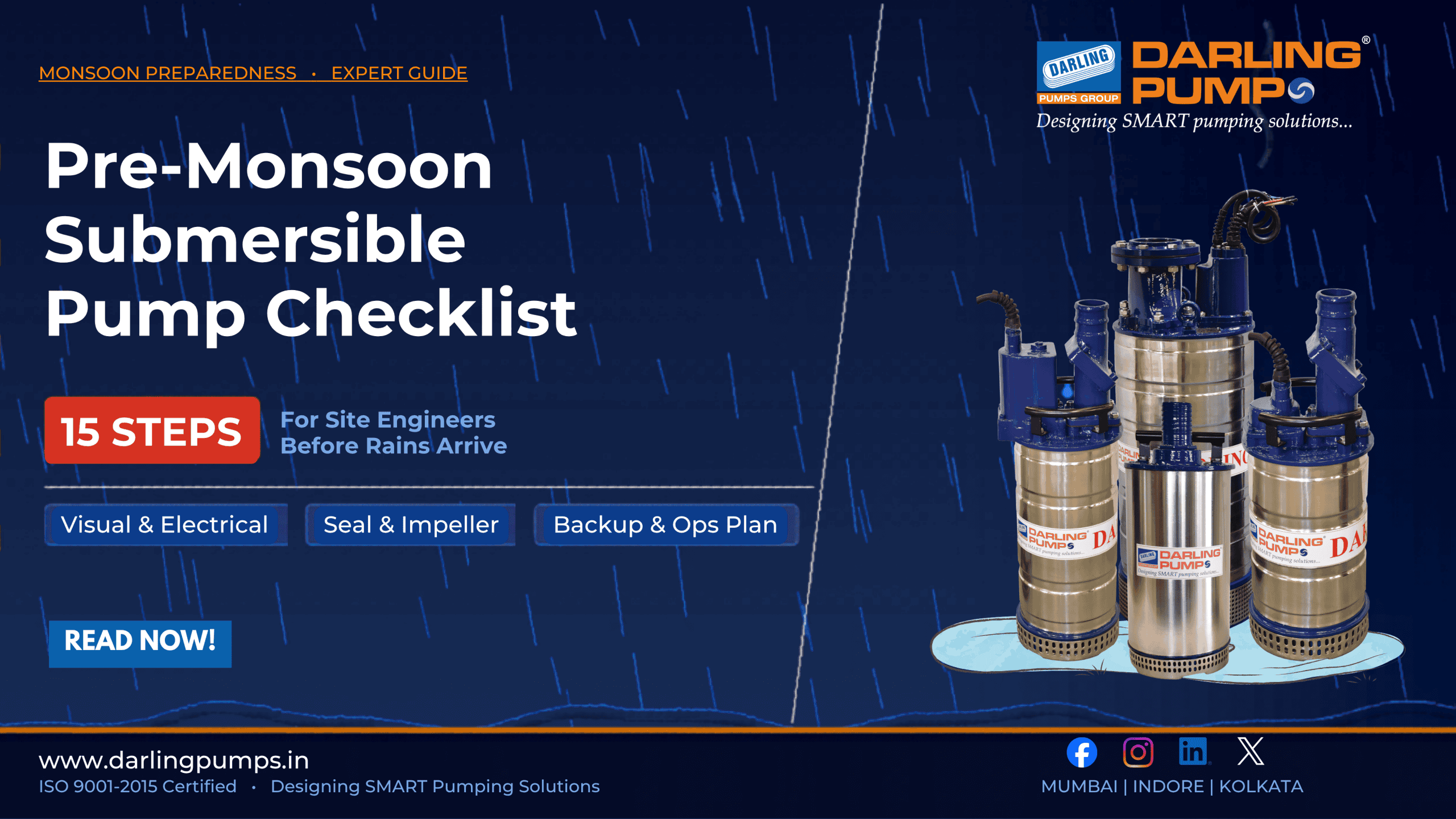
Every year, the monsoon surprises us. A pump that worked fine last season suddenly won’t start. A seal that wasn’t checked for eight months fails when there are three feet of water in the excavation pit, and a project deadline is near.
Site engineers who have experienced monsoons know this feeling. They also know the real solution: don’t wait for the rains to find out what’s broken. Find out before they arrive.
This checklist is for people working on sites. Construction supervisors, plant maintenance heads, drainage system operators, and anyone keeping a site during heavy rainfall. These 15 steps are practical and based on problems that happen at sites and the kind of preparation that prevents them.
Whether you are using dewatering pumps in India, managing a large infrastructure project, or running operations at an industrial plant, this guide will help you prepare for the monsoon season with confidence.
WHY PRE-MONSOON PUMP PREPARATION IS NOT OPTIONAL
Let us be direct about something. Many sites treat pump maintenance as something they do after things go wrong. They fix things when they break. This approach is okay when the weather is calm. Monsoon weather is not calm.
When heavy rain comes, water can build up at a site quickly. This can happen in a few hours. When this happens, it can be very bad for the foundations of the site. The water can affect the structure of the site. In areas where water does not move can be very dangerous. In fields where crops are grown, too much water can destroy all the crops in just a few days. In all these situations, the pre-monsoon preparation of the pump is very important. The pump is the thing that helps you when there is too much water.
If the pump stops working during the monsoon season, it is not a small problem. It stops everything. In most cases, this could have been prevented.
Good submersible pump maintenance done before the monsoon season starts is what makes the difference between sites that keep working and sites that have problems every year. The pre-monsoon pump preparation is what keeps sites safe. Pre-monsoon pump preparation is very important.
THE 15-STEP PRE-MONSOON PUMP CHECKLIST
STEP 1: DO A FULL VISUAL INSPECTION OF EVERY PUMP UNIT
Before anything else, take out every pump from storage or its current location and examine it closely. Check the outer casing for cracks, dents, or corrosion. Inspect the discharge flange and inlet strainer. Any visible damage to the body signals that internal parts may also be affected.
Don’t skip this step just because a pump “seemed fine when we last used it. ” Months in storage can cause damage, especially if the unit wasn’t cleaned and dried before being stored.
STEP 2: INSPECT THE POWER CABLE AND CONNECTIONS
The power cable on a submersible pump takes a lot of stress; it gets pulled, bent, stepped on, and submerged. Before monsoon, run your fingers along the entire length of the cable and check for cuts, abrasions, or worn insulation. Pay close attention to where the cable enters the pump body since that point is under constant mechanical stress.
A damaged cable in a flooded area is a serious electrical hazard. If the insulation is compromised anywhere, you need to replace the cable, not just tape it over.
STEP 3: CHECK THE MOTOR WINDING RESISTANCE
Use a megohmmeter to measure the insulation resistance of the motor windings. This determines whether moisture has entered the motor housing, which happens more often than people think, especially in pumps used in muddy or abrasive conditions.
A healthy reading is usually above 1 megohm. If the readings are low, the motor needs to be dried out or sent for rewinding before use. Catching this before the monsoon starts prevents motor burnout when you need it most.
STEP 4: EXAMINE THE MECHANICAL SEAL
The mechanical seal is crucial for preventing water from reaching the motor. It’s also one of the components most likely to wear out, especially in pumps used for sludge, grit, or construction wastewater. Even a small seal failure can damage the motor within minutes.
If the pump has logged a lot of hours since the last seal replacement, replace it before the monsoon. The cost of a new seal is a small fraction of what replacing a motor or downtime will cost.
STEP 5: CLEAN AND INSPECT THE IMPELLER
Blocked impellers are a common reason pumps underperform or fail during heavy use. Debris like gravel, rags, hardened sludge, or construction waste can get stuck in the impeller and drastically reduce flow or cause the motor to overheat.
Open the pump casing/diffuser, take out the impeller, and clean it thoroughly. While it’s out, check the impeller vanes for wear or chipping. If you regularly handle heavy solids, talk to a pump manufacturing company in India about impeller materials that offer better wear resistance.
STEP 6: FLUSH THE PUMP CASING/DIFFUSER AND DISCHARGE LINE
After a long working season or being idle, sediment and hardened material often build up inside the pump casing/diffuser and discharge pipes. Before the rains come, flush the entire system with clean water. Run the pump for several minutes in a clean water tank and check that the discharge flow looks right; look for unusual noises, reduced flow rate, or vibrations.
This will also help you spot partial blockages in the discharge line that might not be apparent during a static inspection.
STEP 7: TEST THE OVERLOAD PROTECTION AND THERMAL CUTOUT
Most quality submersible dewatering pumps come with thermal overload protection, which shuts the pump down if the motor gets too hot. Before the monsoon, make sure this protection is working correctly.
A pump that runs without functioning overload protection will burn out its motor as soon as it faces a difficult load, which typically happens during flood-level pumping.
STEP 8: INSPECT THE FLOAT SWITCH / WATER LEVEL CONTROLLER (IF APPLICABLE)
Pumps used for automatic water level control depend on a float switch or a water level controller arrangement to start and stop based on the water level. Before the monsoon, test the float switch / Water level controller through its full range of motion. Check that the float moves freely without sticking and no scale formation on the Water Level Probes. Make sure the activation and deactivation points are set correctly.
A stuck float switch or a defective water level probe are some simple problems that can have expensive consequences. It may lead to the pump running dry and burning out, or it might not start when needed, resulting in flooding at the site.
STEP 9: CHECK BEARINGS FOR NOISE AND VIBRATION
Run the pump for a moment and listen carefully. Healthy bearings should be quiet. Worn or damaged bearings create a grinding or rumbling sound, and you’ll often feel vibrations in the pump body.
If you hear anything unusual during your test run, have the bearings inspected and replaced before using the pump. This is especially important for pumps that ran continuously during the previous season, as bearing wear builds up over operating hours.
STEP 10: VERIFY ADEQUATE PUMP CAPACITY FOR YOUR SITE
This step focuses on planning rather than just maintenance. Look at the water volumes your site dealt with during last year’s monsoon. Was the pump keeping up, or was it always running at maximum capacity while water still accumulated?
If your site has expanded, your pumping revenue has increased as well. Pre-monsoon is the right time to evaluate whether you need additional pump units or higher-capacity equipment like the Darling Pump’s Higher Discharge Pumps. Trying to solve an undersized pumping issue during the monsoon is stressful and costly.
STEP 11: PREPARE BACKUP PUMP UNITS
Every important pumping job needs a backup. Pumps can still fail even if you take care of them. A backup unit makes sure that if a pump fails, it doesn’t become a big problem.
Check your units as carefully as your main pumps. A backup pump that hasn’t been used in six months isn’t reliable.
STEP 12: CHECK AND SECURE ALL HOSE AND PIPE CONNECTIONS
Discharge hoses and pipes get stressed during high-volume pumping. Before the monsoon, check all connections to make sure they are tight. Look for cracks in rubber hoses, corrosion on metal joints, and signs of leaks.
Also, make sure the place where you discharge water is clear and easy to get to. A blocked discharge path creates back pressure that can hurt pump seals and reduce flow.
STEP 13: ENSURE EARTHING AND ELECTRICAL SAFETY
Water and electricity are a bad mix. Before the monsoon, check the setup at every pump location. Make sure all pumps are properly earthed. Ensure control panels and junction boxes are sealed against water. Check that circuit breakers and protection devices work correctly.
One unnoticed grounding fault in a flooded area can lead to major problems.
STEP 14: TRAIN OPERATORS ON EMERGENCY PROCEDURES
Preparing equipment only helps if operators know what to do when things go wrong. Before monsoon season, make sure every operator knows how to perform a fault check, what to do if the pump trips unexpectedly, how to safely shut down the system, and who to contact if issues arise.
For sites with staff turnover, this refresher training at the start of each monsoon season is vital for site safety.
STEP 15: DOCUMENT EVERYTHING. Create A MONSOON OPERATIONS PLAN
After completing all the checks, document the condition of every pump, what was serviced, what was replaced, and what was noted for attention. Create a monsoon operations plan that outlines which pump covers which area, the response protocol when water levels rise, and how to escalate if primary systems fail.
This documentation serves as reference material. Year, instead of starting over, you can build on what you already know.
FINAL WORD
The monsoon is coming. The question is whether your pumping systems will be ready for it or not.
Go through this checklist systematically. Document your findings. Address every issue you find before the first major rainfall.
If you need guidance on the right dewatering pump solutions for your specific site, whether it’s a construction excavation, industrial facility, municipal project, or agricultural land, reach out to Darling Pumps. As a trusted pump manufacturing company in India, we’ve been helping sites across the country prepare for and manage exactly these challenges.
Don’t wait for the rains to tell you what’s broken. Find out now, fix it now, and go into monsoon season ready.